Monday, January 20, 2014

Testimonium Spiritus Sancti Internum: The Internal Witness of the Holy Spirit - In Christian Apologetics

In the book, “Five Views On Apologetics,” William Lane Craig makes this statement: “If, by proceeding on the basis of considerations that are common to all parties, such as sense perception, rational self-evidence, and common modes of reasoning, the Christian can show that his own beliefs are true and those of his interlocutor false, then he will have succeeded in showing that the Christian is in a superior epistemic position for discerning the truth about these matters.”[1] In his work, “Christian Apologetics,” Norman Geisler comments, “What is more, an adequate test for truth is a methodological prerequisite to establishing theism.

For unless the Christian apologist has a test by which he can show other systems to be false and theism to be true, then there is no way to adjudicate the conflicting claims of various religions and worldviews.”[2] In His work, “Faith Founded on Fact,” John Warwick Montgomery has said, “Christianity does indeed offer the most comprehensive solution to the human dilemma, but apart from the marshaling of brute facts to prove this, the claim is worth no more than that of any other religion or philosophy leading to maximal comprehensiveness or coherence.”[3]

In their respective comments, it is clear that each man is looking to identify a method and standard by which the truth claims of Christian theism can be shown to accurately reflect the state of affairs as they have obtained in the present world order. Craig uses the expression, “rational self-evidence,” while Geisler points to “an adequate test for truth,” and Montgomery, references “the marshaling of brute facts.” Each man is carefully enmeshed in showing Christian theism to be true. In addition, these men have made vast contributions to Christian scholarship over the course of their respective careers and for that I am grateful. In fact, Norman Geisler was my apologetics professor several years ago at Southern Evangelical Seminary in Charlotte, NC. Nevertheless, there is a very basic difference in my perspective and their perspective concerning what Scripture has to say about apologetic method. That difference is located in the relationship between the Testimonium and the Criterion as it attaches to Christian epistemology.

The thesis of this post is that Christian apologetics is a discipline that necessitates both the force of the truth of God in its expression and the work of God’s Spirit in its function if it is to be harmonious with divine revelation. Unless the gospel of God is presented in concert with the work of the Spirit, the discipline of Christian apologetics becomes much more rationalistic, much more natural, much more the product of the human intellect.

The objective of this post is to trace the contours of the witness of the Holy Spirit in the proclamation and vindication of the gospel as it appears to us in the New Testament revelation. The particular aim is to demonstrate the nature of the ancient church’s dependence on that witness in both its proclamation and defense of the Christian gospel. The apologist must look to the revelation of Scripture for both his cadence and his model for apologetic methodology. It is there that he will find safety from error, pride, and the fruitless rationalism that has come to dominate the discipline.

My aim is to call apologists back to a reliance on the work of the Holy Spirit in the field of Christian apologetics. Christian theism is a supernatural religion from top to bottom. From its Head, to its revelation, to its members, to its message, Christian theism has a spiritual and supernatural base. In fact, there is nothing in the Christian religion that is purely naturalistic in character. Beginning with the creation of the physical universe to the divine revelation of the law, to the arrival of God incarnate, to the completion of divine revelation in the New Testament, there is no component of Christian theism that does not transcend human reason. It seems perfectly right then, that the discipline that purports to defend the claims of this supernatural religion would also be fully persuaded that its approach would require reliance on the very supernatural truth claims it seeks to defend. It is only reasonable to think that the Christian apologist would embrace, without hesitation, the supernatural witness of the Holy Spirit in the work of vindicating the Christian worldview.

“The New Testament is primarily concerned with telling the story of Jesus and with drawing the consequences of that story for belief, for worship, and for practical conduct of human life.”[4] Indeed, in his gospel at 20:31, John informs us that he wrote his gospel so that the hearer might believe that Jesus is the Christ, the Son of God, and that believing, the hearer might have eternal life. Kostenberger points to Matt. 16:13-20 as Matthew’s central thesis.[5] This section contains Peter’s great confession that Jesus is the Christ, the Son of the Living God. Mark begins his project by telling us this is the beginning of the gospel of Jesus Christ, the Son of God. He continues in 10:45 by telling us that Jesus, the Son of Man came not to be served but to serve and give His life a ransom for many. And in 15:39 he records the words of the centurion, “truly, this man was the Son of God.” Luke is essentially a treatise of the historical record of Jesus Christ so that Theophilus might know the exact truth about the things, which he had been taught. The task of Christian apologetics is to provide a defense to anyone that 1) asks us to give a reason for the hope that is in us; and 2) to refute those that aspire to challenge and contradict the truth of God we have in His divine communication. This task requires the Christian to employ both the Spirit and the Word in their preparation for and their engagement in the discipline of Christian apologetics.

If one were to survey the material available on the subject of Christian philosophy and apologetics today, they would discover an astounding and embarrassing deficiency of exegesis and theology in those materials. In addition, very little space is dedicated to the phenomenon of the witness and work of the Spirit in the field of Christian apologetics. It is the primary aim of this series of posts to point out the vital role of the Spirit in the work and practice of Christian apologetics. Christian apologetics is better served when it is in the hands of the exegete, the theologian, and the elder. The philosopher seems to be continually seduced by the intellectually complex, the obscure, and the sophisticated. But the gospel and its defense is more simple than the philosopher wants it to be.


[1]. William Lane Craig, “Classical Apologetics,” in Five Views on Apologetics, ed. Steven B. Cowan and Stanley N. Gundry (Grand Rapids, MI: Zondervan, 2000), 44.
[2]. Norman L. Geisler, Christian Apologetics, paperback ed. (Grand Rapids, MI: Baker Books, 1976).
[3]. John Warwick Montgomery, preface to Faith Founded on Fact: Essays in Evidential Apologetics (Newburgh, IN: Trinity Press, 1978), xi.
[4]. Avery Cardinal Dulles, A History of Apologetics, 2nd ed. (Eugene, OR: Wipf and Stock Publishers, 1999), 1.
[5]. Andreas J. Kostenberger, L. Scott Kellum, and Charles L. Quarles, The Cradle, the Cross, and the Crown (Nashville, TN: B&H Publishing Group, 2009), 179.

Saturday, January 18, 2014

Confronting the Book, "Confronting Calvinism"

This post is part of an interaction I am having with Dr. Anthony Badger, author of "Confronting Calvinism." Hence you will see direct address here and there. Just a heads up on why it is present.

It is not that I misunderstand how Free Grace views faith rather, it is the case that I believe Scripture does not provide an adequate grounding for the Free Grace understanding of faith as passive. With all due respect, you have not made your case. I see that John 6:44, 65 is touched on in the chapter on Total Depravity. I must confess that I find your treatment of it unconvincing. You see then, Jesus talks a great deal about this matter in John 6. There, Jesus says to the Jews that are following Him for all sorts of reasons that they have seen Him and do not believe Him. He contrasts this statement with the statement that “all that the Father gives to me will come to me.” In 39 He tells us that this group that the Father gives to Him, He will certainly raise them up on the last day and not lose a single one. These are the ones that behold the Son and believe in Him. Then in 44 Jesus tells us that no one is able to come to Him unless the Father draws them. And then he says something very interesting, “and I will raise him up on the last day.” In other words, everyone that the Father draws to Him will be raised up on the last day. Logically, we can only conclude that those whom the Father draws are the ones from that group mentioned earlier, the ones that the Father gives to Jesus. I will come back to this momentarily.

Jesus reinforces this concept with a quote from Isa. 54:13/Jer. 31:34, and states quite clearly, “Everyone who has heard and learned from the Father comes to me.” Once again, we can only conclude that everyone who hears and learns from the Father is part of that group that the Father draws to Christ, and these are the same ones that the Father has given to Christ, the ones from whom Christ will not lose a single one but will raise them up on the last day. Now, this describes some of those that are in the crowd no doubt. But what about the other ones who are there for all the wrong reasons? Jesus says in 6:65, “But there are some of you who do not believe.” Now, we ask the question concerning why they don’t believe. Jesus gives us as clear an answer as could be given: “For this reason I have said to you, that no one can come to me unless it has been granted to him from the Father.” This Jesus’ own paraphrase of v. 44. The reason that men do not believe is because it has not been granted to them by the Father. Now, Jesus is saying that men are not able to come to Him οὐδεὶς δύναται ἐλθεῖν πρός με, unless it has been δεδομένον αὐτῷ granted/given to him ἐκ τοῦ πατρός from the Father. Faith and coming to Jesus are equivalents in this text. The idea that Jesus thought of believing in Him separately from coming to Him, coming after Him, following Him is, in my estimation, the product of extreme theological prejudice.

When Dr. Badger uses the word draw, he seems to use it in an anachronistic sense. We think of being drawn to a person, a spouse, something that attracts us when we use this word. However, in order to understand the meaning of “draw” and how Jesus used it, and more importantly, how John’s audience would have understood it, we have to go back to the first-century Mediterranean world. You see, Jesus’ connection between 6:44 and 6:65 should cause us to think more critically about this word. In 6:44 he uses the word ἑλκύσῃ, draw, and in 6:65 He uses the word δεδομένον, granted. In our thinking, grant carries the sense of “actuality” while draw has the sense of “potentiality.”

The Greek word ἑλκύσῃ means to attract powerfully, to haul. This word appears six time in NT usage. In every single case, the object of the attraction is passive. Moreover, in every single place it is used, the idea is to pull or move the passive object to the subject. When we hear the word attract, we think about a psychological sensation, an internal stimulation if you will. That is not at all how this word is used in the New Testament Scripture. Some would point to John 12:32 as proof that Jesus draws in the modern sense of this tugging at the heart, and that He draws all men without exception. But this text is talking about the manner in which Christ will die and the fact that His death will attract from all groups of men on the earth just as God has planned. Surely the text does not mean all men without exception for we know that men die even today without ever having heard of Jesus’ death on the cross. And if you reject this view, then surely you must acknowledge that men have died since the resurrection of Christ, having never heard of the event. In that case, Jesus could not possibly have intended for us to take this text in a naïve and literal manner.

Now I turn to the question of “believing.” Is “believing” an active or passive behavior? Free Grace contends that “believing” is passive behavior. The Greek word πιστεύω appears 241 times in the NA28 GNT. It appears in the passive voice nine out of those 241 times and in the active voice 232 times. This puts its usage as passive at about 4% of the time. The passive usages occur in Rom. 3:2 where the Jews were said to have been entrusted with the oracles of God, in 1 Cor. 9:17 where Paul was entrusted with a stewardship, and then in Ga. 2:7, 1 Thess. 2:4, 1 Ti. 1:11, and Tt. 1:3, all places where Paul is said to have been entrusted with the gospel. In 1 Tim. 3:16, use of the passive occurs in its most common usage as it describes Christ has having been believed on in the world. In 2 Th. 1:10 the reference is to Paul’s testimony that was believed. In eight of the nine passives then, we see that the subject of belief is not the occasion for saving faith. This leaves us with one example out of 241 in the GNT. This brings us to Romans 10:9-10. Paul says in v. 10, “For with the heart a person believes.” Once again, this is the standard use of a passive voice verb. It is simply describing the instrument of belief, namely, the human heart. One has to look no further than v. 9 to see that if a person will believe with their heart that God has raised Jesus from the dead, they will be saved.

In Acts 16:30, the Philippian Jailer wanted to know how to be saved. Paul commanded Him to believe in the Lord Jesus and he would be saved. Now, not only is πιστεύω in the active voice here, it is in the imperative mood. This is the mood of command. How can Paul command the Jailer to actively believe in the Lord Jesus if that act is actually passive in nature?

In summary then, the hypothesis that the act of believing has nothing to do with the human will lacks exegetical warrant. The sense of πιστεύω moves from an evaluation to acceptance (knowledge) to belief to trust and understanding. It means to consider something to be true and worthy of one’s trust, to entrust oneself to and entity with complete confidence, to entrust, to be confidence about (BDAG). From this it seems easy to see that Free Grace is wrong to view belief as a passive human behavior. It seems to follow that if belief is passive, then so too is unbelief. After all if belief that Jesus is Lord is passive, then so too is belief that He is not Lord. And if that is the case, I fail to see how God can hold men culpable for their refusal to believe the gospel. You see, even Calvinism does not hold that men are culpable for actions they do not freely will or chose to do. Calvinism argues that men willingly choose not to believe the gospel. Calvinism does not hold that men want to believe the gospel but cannot. It teaches that men love their sin, and that they are not able to believe because they only love their sin and as a result they are unwilling to believe. In addition, Free Grace seems to overlay a modern, emotional sort of definition on the word “draw” in John 6. Once we travel back to the NT world to understand better how that audience viewed the word, we are in a much better place to understand how Jesus could use it interchangeably with God’s granting belief to those whom He has chosen to give to His Son.

Romans 10:9 teaches that if a person will believe the gospel, they will be saved. The ones who will believe are those whom the Father gives to the Son. These are the ones that Jesus said would have eternal life and be raised up on the last day. Only this group can come to the Father because the Father grants it to them to come. That is to say, the Father powerfully attracts these elect to the Son. The reason men do not believe Jesus is because they are not His sheep and are of their father the devil. Only those who are born from above are willing and able to believe the announcement of Jesus Christ! The rest willingly reject the good Word about Him.

Monday, January 13, 2014

The Incongruity of Probability Theory in Christian Evangelism and Apologetics


In a recent article published in Philosophia Christi, Richard Swinburne came to the following conclusion: “I conclude that unless my assessment of how probable the evidence of natural theology makes the existence of God is very badly mistaken, it is very probable that Jesus was God incarnate and that he rose from the dead.” Now, isn’t that a forceful, impressive, and eloquent way to speak about what Christianity claims is the single greatest event in all of human history. Before I begin commenting on Mr. Swinburne’s astounding conclusion and the confidence with which he makes it, the reader needs to understand that I come to this subject as a theologian and biblical exegete, not a philosopher. I am an apologist, but only in the sense that I think every believer has a duty to engage in apologetics. However, my education and training are not in philosophy. My education is in theology, systematics, and the biblical languages, in hermeneutics. Therefore, what my scrutiny and criticism will lack in philosophical rigor, it will certainly compensate for in theological and exegetical carefulness.

The fundamental problem with Swinburne’s approach is that it does not appeal to Scripture for its epistemic authority, but rather to human reason. It is obvious that Swinburne appeals to human reason, to argumentation, to historical evidence as his final authority for believing that Jesus was God incarnate and that He rose from the dead. In fact, what Swinburne really believes is that it is reasonable for a person to believe that Jesus is God incarnate because the historical evidence makes it highly probable that He was. Swinburne and other non-reformed philosophers and so-called apologists continually accept the criteria of justification that godless philosophers place on them. The unregenerate rationalists and empiricists insist that all beliefs must meet their criteria in order to qualify as true knowledge. Since these philosophers use inductive logic, which is based on probability, certain knowledge is impossible. If a Christian does not challenge this strategy at the beginning, their conversation will be wrought with insurmountable objections.

The resurrection can only serve as evidence for Christian theism within the world of the regenerate. The problem with Swinburne’s view is that he and other philosophers separate the epistemological significance of the resurrection from its soteriological function. This sort of reasoning fails to adequately account for the ethical problem deeply embedded in unregenerate epistemologies. Natural theology is far too optimistic in its estimation of man’s ethical neutrality where epistemology is concerned. Scripture is clear on this point: “For since the creation of the world His invisible attributes, His eternal power and divine nature, have been clearly seen, being understood through what has been made, so that they are without excuse.” (Rom. 1:20) The Greek word translated “without excuse” is ἀναπολογήτους (anapologetous) and it literally means without an apologetic. There is no philosophical defense for refusing to acknowledge God, according to Romans 1:20. It is amazing to me that with great frequency, Christian philosophers actually pretend there is one. Since Scripture already says that God Himself has furnished all the proof that every unbeliever need in order to acknowledge Him, we need not waste our time trying to provide them with more proofs. Are we silly enough to think that our arguments and proofs are somehow superior to or more effective than the ones God has etched in their conscience and placed in front of their noses?

 I read Swinburne’s quote to my wife this morning and I asked her to tell me what was wrong with it. She immediately said that she did not like the sentence “it is very probable that Jesus was God incarnate and that he rose from the dead.” I asked her to explain to me why she believed the statement was wrong. Her answer was very simple but also quite profound: “because it is not true.” I asked her to elaborate. She quipped, “Jesus actually is God and actually did raise from the dead and so to say that he probably is and did these things is false.” The truth is that my wife is absolutely correct.

A major objection to Swinburne’s statement is that biblical Christianity does not teach that it is highly probable that God exists, that Jesus was probably God incarnate, and that He probably rose from the dead. Hence, Swinburne is essentially defending a belief that is not included within Christian theism. Christian theism teaches forcefully and with absolute certainty that Jesus Christ was God incarnate, that He absolutely rose from the dead for our justification, and that all those who place their faith in Him will have eternal life. Additionally, Christian theism certifies without any hint of doubt that those who reject this message of the gospel of God will surely perish and come under eternal wrath, time without end.

Another challenge concerns the reliance on probability as a valid method for arriving at what is likely the truth. What else must absolutely be true in order for probability to be true? The answer is that the validity of uniformity must be true in order for probability to be valid. We must be able to show that there is a relationship between the general and the particular. This is exactly what the unbeliever cannot do. He assumes such a relationship exists but he cannot provide an adequate accounting for it. If the world came to exist on its own, randomly, by accident, without a cause, then there is no way for us to account for any relationship between the general and the particular. Chance and uniformity are not exactly related. As we would say in the south, they’re not even distant cousins. In fact, they are opposites. Why then do Christian philosophers feel compelled to accept basic beliefs about how the world operates when these beliefs are in clear contradiction, not only with Christian theism, but also with the system with which they argue? It makes very little sense as far as I can tell.

Romans one clearly informs Christians that God has made Himself known to all men. ὁ θεὸς γὰρ αὐτοῖς ἐφανέρωσεν is very clear. For God made it very plain to them. The word means to cause something to be fully known by revealing clearly and in some detail—‘to make known, to make plain, to reveal, to bring to the light, to disclose, revelation. This very same word is used in 2 Cor. 5:11, θεῷ δὲ πεφανερώμεθα, we are fully known by God. Jesus used it in John 14:21 where He promised to make Himself known to the one keeping God’s commandments. Therefore, when the unbeliever claims they do not know if God exists or when they claim that God does not exist, they lie. The question for the Christian is will we go along with that lie. Will we grant to them that which Scripture denies?

In short Swinburne’s view does not hold up under scrutiny. The very systems that use probability as a reliable test for knowledge cannot stand up under the scrutiny of their own basic claims. For instance, what happens when probability is turned on itself in a random universe? How probable is it that this world would exist in the first place? It was a one-time event. Probability does not work with one-time events. The Christ event was a one-time event. The resurrection was a one-time event. Supernatural creation of humanity was a one-time event.

In addition, probability would never be the most likely explanation for a miracle of any kind. Deceit, or delusion or exaggeration would always trump supernatural phenomena in terms of probability. It would always be more probable that someone is lying, or suffering a delusion or simply exaggerating than it would that a miracle occurred. Hence, if we concede this point of probability, the entire system of Christian theism collapses.

Christians are called to give an account for the hope that is in them. We are under no obligation to squabble with unbelievers over the existence of God or the truthfulness of the claims of Scripture. We are under an obligation to refute claims that contradict the teachings of Scripture. But that refutation does not take on the philosophical nature of unbelieving presuppositions. The refutation is Scripture. How do we refute error? We do it the same way Jesus did it: with Scripture. We don’t need to argue for why we call upon Scripture as our sole authority, outside of appealing to Scripture itself. The unbeliever cannot possibly defend their ultimate authority of autonomous human reason. They expect us to assume that human reason is completely reliable. But we all know that is not the case.

To argue that God probably exists, and that the Bible is probably God’s word, and that Jesus is probably God incarnate, and that He probably rose from the dead is also to argue that we are all probably saved and that Jesus is only probably returning one day and that divine judgment will probably happen in the future, probably. For God who probably exists probably so loved the world that He probably gave his only begotten Son! Is that the gospel? I can say with absolute certainty that this, ladies and gentlemen is not the Christian gospel. I believe it is time we begin to wrest the gospel from these philosophers that foolishly think that Christ and Aristotle can be friends. I think it could not be clearer that they are mortal enemies.


Friday, January 10, 2014

Christians, Culture, and Moral Conduct


There is no New Testament mandate directing the Christian community to shape the moral values of a godless culture apart from the actions of living and preaching the gospel visibly and flagrantly. Modern western Christianity is predominantly a naturalistic, rationalistic, moralistic system utterly oblivious of the supernatural basis that defined ancient biblical Christianity, and for centuries, historic orthodox Christianity. The modern western religion that has come to be known as Christianity is little more than naturalistic, rationalistic deism. The most basic components for how Christians know divine truth, specifically, biblical faith coupled with Spirit illumination, are utterly foreign concepts to most people in modern culture who refer to themselves as Christians. The biblical teaching that our basis for truly knowing God is beyond the veil of human reason sounds strange to most professing Christians in western culture, and I would suppose, to most other cultures as well. This naturalistic, rationalistic orientation of the Christian religion has instinctively led many professing churches to consider the mission of the Christian church from more of a social, moral, and temporal emphasis.

Recently I heard a rant over the new trend to legalize polygamy. Al Mohler rightly pointed out that those gay marriage proponents that called the polygamy argument the product of extremists were dead wrong. That being the case I want to bring you back what I believe is the appropriate attitude regarding ungodly behavior and values in the culture.

First, in his prologue, John is very lucid in his description of how an ungodly culture, living under the curse of God and abiding in His wrath responds to true light: “The Light shines in the darkness, and the darkness did not comprehend it.” (Jn. 1:5) It is thought that John is alluding to Isa. 9:2, “The people who walk in darkness will see a great light; Those who live in a dark land, The light will shine on them.” Similarly, in the Dead Sea Scrolls, the forces of light and darkness were engaged in mortal combat, but light was predestined to triumph.[1] 
Light and darkness are no equally matched duality, but in the titanic battle between Jesus and Satan, Jesus, “the light,” emerges as the overwhelming victor.[2] 
There is no question that darkness and light occupy the same culture in many of the world’s cultures. Those in whom Christ dwells, the Christian community, are the children of the light. The unbelievers that reject Christ are referred as children of darkness.

The second point is that a little later in his gospel, John informs us why ungodly cultures prefer the darkness rather than the light: “This is the judgment, that the Light has come into the world, and men loved the darkness rather than the Light, for their deeds were evil.[3] 

The world not only loves the darkness, but they also are fearful that their evil deeds will be exposed if they step into the light. Sinners love their sin. If you thought gay marriage, and polygamy and abortion are human rights issues, you could not be more mistaken. These are all sin issues, issues of a very dark, godless culture that seeks to have things its own way. No amount of social or political activism will change the darkness in our culture to light.

What then is the Christian to do? Are we to wrangle over sinners living sinful lifestyles? Our response should not be one of simple outrage over the attack on the family, or even on the lives of innocent unborn babies. Our shock should be the utter contempt in which God is held. But that shock should be an expected shock if you will pardon the oxymoron. Paul had an emotional response to the idolatry he witnessed in Athens, but it was predictable. What should we do? How should we think about this when we are alone and contemplating the evil around us? What should we do about it? Should we talk about it? Should we vote about it? Should we seek to force the godless culture to live by godly values if at all possible? What exactly is the Christian community to do about the godless cultures in which they find themselves?

Many modern politically active Christians claim that political activism is the equivalent of letting our "light shine" and of being "the salt of the earth." Others believe these good works are the outward behaviors of righteous living. I am convinced by Jesus' reference to the Law that He was alluding to righteous living. Jesus says we are the salt of the earth. Scholars are not sure what Jesus was referring to specifically when He called us the salt of the earth. He could have been alluding to rock formations that contain sodium chloride. These were used to preserve meat. He could have been alluding to the salt collected from the Dead Sea through the process of evaporation. He could have had in mind the salt blocks used by Arab bakers to line the floor of their ovens. “Jesus may be citing a well-known proverbial saying. When rebuffing a trick question, Rabbi Joshua ben Haniniah (c. a.d. 90) apparently alludes to a proverbial saying when he asks, “Can salt lose its flavor?” The context of the saying implies that it is impossible for salt to lose its flavor, because he parallels the saying by asking, “Does the mule (being sterile) bear young?” (b. Bek. 8b). Sterile mules can no more bear young than can salt lose its flavor.”[4]

In other words, one cannot be light and darkness both at the same time and in the same place. This would point to the fact that the disciples of Christ could not possess the qualities of a disciple and not possess the qualities of a disciple at the same time. The fruit of the Spirit in Gal. 5 comes to mind.
Peter tells his audience to “Keep your behavior excellent among the Gentiles.” (1 Peter 2:12) Paul emphasizes this sort of conduct in 2Cor. 8:21, “for we have regard for what is honorable, not only in the sight of the Lord, but also in the sight of men.”[5] 
In a culture obsessed with shame and honor, Greco-Roman writers were quick to emphasize that leaders and other beneficiaries of the public trust must be open and of irreproachable moral credentials. Judaism also stressed that charity collectors must act irreproachably to prevent even false accusations.[6] 
Outward moral reform was clearly not in view in the gospels, nor is it found anywhere in the writings or rhetoric of the NT sermons. Paul tells us to “prove ourselves blameless and innocent children of God above reproach in the midst of an immoral generation, among whom you appear as lights in the world.” (Phil. 2:15)

The biblical mandate for the Christian is to live a certain lifestyle before the world, not necessarily to tell a godless culture that it must comply with Christian principles or else. The Christian message is the gospel of repentance. The “or else” has nothing to do with temporal punishment and everything to do with the coming wrath of a Holy God. We will continue to write about the wrong-headed thinking of so many Christians as it relates to how we are to think about and interact with the respective godless cultures in which we find ourselves. The goal of the Christian life is to honor God before men. That means being the light and the salt He has called us to be and unflinchingly proclaiming the gospel of Christ, making disciples everywhere we go!

In summary then, Jesus and His apostles left us with clear instructions to live a life that was above reproach, to let our light shine, to hold to a standard of ethics that was of immeasurable worth. He commanded us to proclaim that gospel without apology. He instructed us to walk in love toward one another and those without, to be at peace with each other, and to walk in unity. He even commanded us, as part of our living in this life, to be continuously making disciples. But not one time did Jesus ever suggest, imply, infer, or even hint that our aim, our goal as a community was to impact the morality of the culture in which we find ourselves. The idea that Christianity has a divine imperative to shape the moral values of a godless and immoral culture in any way other than through godly living and preaching the gospel is a modern impulse derived from a rationalistic and naturalistic view of the Christian religion.


[1] Craig S. Keener, The IVP Bible Background Commentary: New Testament (Downers Grove, IL: InterVarsity Press, 1993), Jn 1:5.
[2] Clinton E. Arnold, Zondervan Illustrated Bible Backgrounds Commentary: John, Acts., vol. 2 (Grand Rapids, MI: Zondervan, 2002), 7.
[3] New American Standard Bible: 1995 Update (LaHabra, CA: The Lockman Foundation, 1995), Jn 3:19.
[4] Clinton E. Arnold, Zondervan Illustrated Bible Backgrounds Commentary: Matthew, Mark, Luke, vol. 1 (Grand Rapids, MI: Zondervan, 2002), 36.
[5] New American Standard Bible: 1995 Update (LaHabra, CA: The Lockman Foundation, 1995), 2 Co 8:21.
[6] Craig S. Keener, The IVP Bible Background Commentary: New Testament (Downers Grove, IL: InterVarsity Press, 1993), 2 Co 8:20–21.

Tuesday, January 7, 2014

The Responsibility of Biblical Interpretation


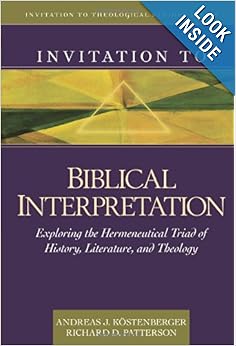
Few things are more rewarding and few things are more dangerous than interpreting divine Scripture. The Scripture itself informs us that those who misinterpret it do so to their own destruction. (2 Peter 3:16) Paul commanded Timothy to be diligent to present himself approved to God, accurately handling the word of truth. (2 Tim. 2:15) The idea is that responsible biblical interpretation begins with an eagerness to present oneself approved to God. Hence, the driving force behind biblical interpretation is an eagerness for and a pursuit of biblical sanctification. Additionally, the single greatest failure in the general ranks of the Church is a lack of interpretive method. The lack of methodology in biblical interpretation leads to a profound lack of discipline and focus and serves as one of the greatest contributors to interpretive failure. This post offers what I believe is an excellent method for how every interpreter should approach the text of Scripture. Much of the content can be found in the book, Invitation to Biblical Interpretation.

The art and science of biblical interpretation is not without challenges. The interpreter brings four realities to the task of interpretation that represent serious peril. The interpreter has a sin nature that at every turn is inclined to rebel against divine truth. Any interpreter would be foolish not to recall the words of Jeremiah the prophet, "The heart is more deceitful than all else and desperately sick; who can understand it?" (Jer. 17:9) There is nothing more deceitful than the human heart! My heart is the most deceitful of all deceiving things! I cannot listen to my heart because my heart is not trustworthy. Second, the interpreter must deal with the reality of salvation history. God has revealed himself to humanity in real space and time. Failure to recognize the distinctive characteristics of that revelation tends to lead to illegitimate forms of criticism that impede the work of the Spirit in our hearts through the text itself. In such circumstances, Scripture becomes little more than an intellectual fascination. Additionally, the interpreter must deal with the literary aspects of Scripture. Divine revelation comes to us via the written text. This text contains foreign and ancient languages, genres, and devices with which the interpreted must become familiar. Finally, the interpreter must deal with the theological reality of the revelation that is divine Scripture. God is communicating divine truth with eternal consequences and there is nothing I can think of that is more significant than that. The interpreter, to show themselves approved to God, must responsibly deal with these four realities: sin, history, literature, and theology.

The reality of sin

The psalmist David said, "Your word I have treasured in my heart so that I might not sin against you. (Ps. 119:11) Sin has a profoundly blinding effect on the would be interpreter. It is ever present and the interpreter must maintain the attitude that the possibility of perversion is a constant threat, especially in handling divine truth. A serious threat to responsible interpretation is the interpreter's personal presuppositions. In many ways, sin is responsible for numerous presuppositions. If the interpreter neglects to deal with their heart biblically, and to take sin seriously, the presuppositions they carry to the interpretive process will only make matters worse. The process for biblical change begins with the confrontation of the Spirit and the Word. The Scripture first threatens us, and specifically, threatens the sin we so dearly long to keep. Hence, there is a built-in incentive for the interpreter to interpret irresponsibly. This incentive is inescapably part of the sin nature. In summary then, there is no shortcut in the preparation process for biblical interpretation. The scholar has as much work to do here as the Sunday school teacher. There is no difference. Responsible biblical interpretation begins with the interpreter's process for dealing with their heart, for recognizing the sin that is there, and proceeding with great caution and with great anticipation for what God is speaking in the text.

The reality of salvation history

The historical dimension of divine revelation is one that has been over-emphasized by some interpreters while others have managed to hardly give it a wink and a nod. Interpreters that focus all their time on the historical aspects of Scripture to the neglect of its literary or theological aspects often end up with little more than a shell. Modern interpreters, ignoring their sinful presuppositions, focusing on the historical aspects of Scripture and treating it like any other book tend to purge it of its supernatural aspects. This approach diminishes the idea of divine revelation, inspiration, and authority. In addition, it has the regrettable effect of undermining the credibility and trustworthiness of the biblical account.

The literary reality of Scripture

Product DetailsThe literary reality of Scripture is one of its most demanding aspects in terms of intellectual skill. Literary analysis is an art and a skill that requires a high degree of focus and energy. However, literary acumen also presents a threat to the message and purpose of Scripture not to mention its nature. A mere literary approach to Scripture has led many to ignore the historical dimensions of the text, and as such, has resulted in Scripture being treated like any other book. Kevin Vanhoozer labels it "aesthetic theology." This results is more knowledge about the text rather than knowledge of what the text is about. The responsible interpreter seeks both, knowledge about the text, and knowledge of what the text is about. The text is divine communicative action with perlocutionary intent. It is not enough to acquire literary knowledge about the text. One must also know what the text is about. This moves us in the direction of authorial intent. God moved to the author but He also moved the author with the intention of producing change in the audience. An overly literary approach to Scripture has led many to Derrida's deconstructionism and the reader-response approach to interpretation. The goal of finding the author's meaning, divine or human, is replaced with the reader's own subjective idea of what the text means to and for them. Adjudication of theological ideas and interpretive methods dissolves, sinking into a sea of relativism.

The theological reality of Scripture

"Thinking biblically is a matter of reading Scripture along the grain of the text. It is less a matter of "drawing out" discrete theological propositions than of "drawing together" scriptural material from across the canon." [Vanhoozer, Remythologizing Theology, 189 quoting Reno, Biblical Theology & Theological Exegesis, 404] Hence, the theological reality of the case is that divine revelation takes place in real space and time, and is captured in real human language. The interpreters failure to account for the historical and literary realities of Scripture is no less damaging to the text than the aforementioned errors. When theology ignores the historical reality of revelation, the resurrection can easily be reduced to myth and regeneration can be "recast as the result of an existential encounter with God occasioned by the reading of Scripture. [Kostenberger/Patterson, Invitation To Biblical Interpretation, 78]

"The rank and importance of Biblical Hermeneutics among the various studies embraced in Theological Encyclopedia and Methodology is apparent from the fundamental relation which it sustains to them all. For the Scripture revelation is itself essentially the centre and substance of all theological science. It contains the clearest and fullest exhibition of the person and character of God, and of the spiritual needs and possibilities of man." [Terry, Milton. Biblical Hermeneutics, 21]


All Scripture is inspired by God and profitable for teaching, for reproof, for correction, for training in righteousness; so that the man of God may be adequate, equipped for every good work. (2 Tim. 3:16)

Sunday, January 5, 2014

A Manual for Creating Atheist: Strict Rejoinder


At the very heart of MCA rests an unspoken assumption. It is an assumption that Boghossian never mentioned throughout the entire project. And yet, it is so excruciatingly obvious that if the project were going to be a success, this assumption could not remain an assumption. Somewhere along the way, Boghossian had the duty to deal with the one very critical issue that he never bothered to address. That critical issue is basically this: Christian faith is never placed beneath or subjected to the authority of human reason. In case you are wondering, this is the philosophical problem of the criterion. It is a legitimate problem that Boghossian prefers to ignore. According to Christian theism, human reason does not set itself up as the magistrate over faith. Since when is Christian epistemology under any obligation to subject itself to rationalism or empiricism? Neither of these systems is willing to submit to a distinctly Christian epistemology, are they? Boghossian assumes that the Biblical faith of Christian theism is subject to the standards of human reason that he wishes to place upon them. He never bothers to show us why his standards are superior or absolute. Rather than show us how Christian theism must pass the test of his version rationalism or empiricism, or a combination of the two, Boghossian assumes that it is so. He could not be more wrong. Christian theism actually argues that human reason must serve as the minister of faith, not her magistrate. Human reason is in service of Biblical faith, not the other way around. I believe so that I may understand, not I must understand in order to believe. This is Biblical Christianity. This is Christian theism. (Think of Leonidas in 300: this is Sparta!)

In “Loc. 452” Boghossian makes this statement: “If a belief is based on insufficient evidence, then any further conclusions drawn from the belief will at best be of questionable value.” Frist, there are some critical questions that this statement must answer. Second, we want to examine what results when we turn this statement on Boghossian’s claims. From a critical perspective, Boghossian has to distinguish in detail, without ambiguity, what he means by sufficient evidence so that we understand what he means by insufficient evidence. He also needs to help us understand what qualifies as evidence. Finally, it would be helpful for him to provide some understanding of how he defines value in terms of argumentation. What happens when we use this single statement to criticize Boghossian’s view of religion? The answer is really quite simply. Since Boghossian rests the success or failure of his entire project on his belief that the accurate characterization of faith is “pretending to know something you do not know” we are in a sound position to be able to assess the quality of his project and determine if it in point of fact adds value to the conversation. This will not be a small criticism that I will level against Boghossian’s argument.

Boghossian’s appeal to human reason to argue for human reason is viciously circular. One would assert that Christian theism does the very same thing with faith. But this statement does not actually represent the facts, as they exist within Christian theism. Christian theism does not appeal to faith as its final authority. Instead, Christian theism appeals to Scripture as its final authority and its criterion for what qualifies as the only consistent worldview, the only valid epistemology. Scripture sets itself up as the authority to which all human predication must submit. The skeptic may claim this too is circular. In response we say it is not viciously circular because as far as Christian theism is concerned, we are speaking of God’s rightful claim of absoluteness in this case. If God does exist as the ultimate source of all knowledge, then what other source could He appeal to but Himself since he is the highest authority to which appeal could be made? In other words, Christian theism is consistent to appeal to their final resting point, namely God, in support of all human predication. To rest the argument on other grounds would be terribly inconsistent even if some Christians actually do so. Should it surprise anyone that opposing systems would appeal to two different authorities for their criterion of belief, and would actually hold to differing epistemological schemes? Boghossian ignores the problem of the criterion and instead pretends that philosophy has it all figured out and that philosophers are in complete agreement on how human knowledge works. Apparently he is unfamiliar with Michael Williams work on “Problems of Knowledge – a critical introduction to epistemology.” Williams says, “The problem of unity poses the question: is there just one way of acquiring knowledge, or are there several depending on the sort of knowledge in question?” [Williams, Problems of Knowledge, 2] Boghossian does not even acknowledge that there are different kinds of knowledge, and hence, different methods for knowing them. 

This is not a small problem in his project. It is one of the first questions a good Christian thinker will ask if you attempt to engage him/her on the question of Christian theism. The problem of the criterion is a most thorny problem. You see, in order to create a criterion by which beliefs may be justified, you must already have some idea about it before you create it. This is a problem. What you are searching for is something that transcends, a standard that comes from out there somewhere. You are looking for a reliable and dependable judge. But if you create the judge, how objective is that? This is the problem of the criterion that Boghossian ignores entirely. The atheist needs to understand that the Christian thinker will not ignore that problem. The minute you ask us to justify our beliefs, we are going to ask you to justify your idea of justification without appealing to your own idea of justification. But don’t let this dissuade you from engaging Christians. I hope you engage lots of Christians, real ones, the type that actually know how to think well about Christian theism.

The second problem with Boghossian’s project is his insistence on giving faith a philosophical or rational definition as opposed to allowing the faith community to define their own terms. “If facts alone are at stake, on overdose of emotionally tinged language can only be a hindrance and should be regarded with suspicion. Even eloquence should be shunned where information is the sole purpose. For facts are most effectively conveyed when they are stated in a plain and objective manner.” [Engel, With Good Reason, 71] When defining faith Boghossian should have just stuck with the plain facts of how Christian theism defines faith rather than not only assigning to it a wrong definition but an emotionally charged one at that. The common Hebrew words for faith are ‘aman, the act of believing or trusting, batah, the idea of being secure, trust in, hasah, seek or take refuge, shelter, and hesedh, faithfulness, loyalty. [McManis, Biblical Apolgetics, 381-383] There are others but you get the idea. The NT encapsulates the idea of faith in the word, pistis. In Christian theism, faith means laying hold on the promises of God in Christ, relying entirely on the finished work of Christ for salvation, and on the power of the indwelling Holy Spirit of God for daily strength. Faith implies complete reliance on God and full obedience to God. [Morris, Illustrated Bible Dictionary, 498] Given that Boghossian’s aim is to refute faith, and given that his entire definition of faith is categorically false, I could end my review here and conclude with any rational person that Boghossian’s project is an embarrassing failure. But I have a few more things to say.

The third challenge with Boghossian’s project is that it is far too broad. It is an illegitimate practice to lump all the religions of the world into the same category just as much as it is to lump all philosophies and philosophers into the same category. I suppose this move would make the task at hand much easier, but it simply does not work. For example, to compare Mohamed with Christ and radical Islam with Christianity is an ad hominem attempt to polarize the conversation. If a person is familiar with radical Islam and unfamiliar with Christian theism, they would be tempted to think that Christians are also strapping bombs to their chest in certain parts of the world and murdering innocent people all under the guise of religion. This tactic is despicable and reflects the desperation and weakness in Boghossian’s arguments. My experience has been that only the weakest arguments resort to ad hominem. Anyone that knows anything about world religions knows that they tend to be radically different from each other in very basic ways.

Another serious problem with Boghossian’s skepticism is that it contains far too much certainty. He speaks as if philosophy has attained absolutely epistemic certainty when in reality the state of affairs is just the opposite. The consensus necessary to arrive at some of the absolute statements that Boghossian makes simply does not exist. The truth is that rationalists and empiricists do not agree even among themselves on the exact nature, definition, limits, and even value of human knowledge. How is it, then, that Boghossian can lead his readers to believe that philosophy has arrived at uncontroversial views in epistemology and metaphysics?

In addition, Boghossian’s insistence on referring to faith as a virus or mental condition to be cured is one of the most bizarre and extreme ad hominem arguments I have encountered. There is no question that this view of faith represents only a small portion of skeptics and the rest would do well to avoid it and him. Every noetic structure, be they primarily rational, empirical, or something else, at the end of their chain beliefs, arrives at faith. Because we are not omniscient, this reality is impossible to avoid and it is one we cannot afford to ignore. As Boghossian himself boasts, there are a lot of things we simply do not know or understand. Christian theism affirms that God created the world from the beginning. At the same time, Christian theism confesses that it does not know how God could do such a thing. We just don’t know. We also do not know how God could bring us the Scriptures as a product of both man and God Himself. We know He did it, but we do not know how that worked. Quite frankly, it is borderline insane to refer to faith as a virus or mental illness. In addition, for a state employee to encourage professors to punish kids with faith, as part of his strategy to purge faith from society, suggests a totalitarianism that should frighten not only the Christian. It should frighten everyone. What is the next item on Boghossian’s list? What else does he not like about society that makes it less than the perfect society according to his ideas? Seems to me that there was a monster in Europe not that long ago who also thought there were elements in society that made it less than desirable.


The final challenge I wish to point out is the lack of coherence in Boghossian’s philosophy, or noetic structure. His system is self-referentially incoherent and I now wish to list the reasons why this is the case. In the first place, Boghossian promotes the idea of creating skeptics. But his own system displays a level of certainty about things that no skeptic could hold. Boghossian pretends that human reason is neutral, that it is simply there. It is as if there is nothing upon which human reason rests, no ground. But this cannot be the case. Even human reason requires a ground. And that ground cannot be its own self. A thing that rests upon its own self is at once absolute and self-sufficient. Human reason has been wrong far too often and admits to far too many limitations for it to be absolute and self-sufficient. “A complete demonstration of each of our beliefs by means of other independent beliefs cannot be given.” [Bahnsen, Always Ready, 198] In order for Boghossian’s system to work, he must supply a set of standards to which all humanity can appeal as absolute and self-sufficient. But this he cannot do, and he does not attempt to do. Perhaps he realizes how irrational such an attempt might be. Boghossian requires neutrality on the subject of God and faith before he can get his project going. However, neutrality on such matters is impossible. Boghossian has an ax to grind and it emerges at the very inception of his project. In fact, it is the catalyst for his project. Boghossian requires the very thing he denies in order to make his project meaningfully intelligible: a certain standard. He criticizes faith for lacking evidence, but cannot provide any evidence for the very logic he uses to make his criticism. He defines faith incorrectly as pretending to know what you do not know and then proceeds himself to do just that! 

Boghossian pretends to know that faith cannot possibly be accompanied with good reason. But when asked to provide justification for his view on justifiability, he is silent. In order for Boghossian’s system to work, it needs to justify itself apart from the nauseating “that’s just the way it is” non-answer answer we hear so often. If you ever hear someone say, that’s just the way it is, you should know that is not a statement of reason, but rather, a statement of faith. It is not biblical faith mind you, but it is the sort of philosophical or rational definition of faith that is often confused for biblical faith. Boghossian’s view is self-referentially incoherent because he insists that faith has no foundation and that this is good reason to rid it of society when his own system also rests ground that also is without a foundation. By the way, faith is actually grounded in God. “The non-Christian rejects the Christian view out of hand as being contradictory. Then when he is asked to furnish a foundation for the law of contradiction, he can offer nothing but the idea of contingency.” [Van Til, A Survey of Christian Epistemology, 204-5]

Saturday, January 4, 2014

A Manual for Creating Atheists: Academic Religious Bigotry


It is in chapter eight that Peter Boghossian’s true colors emerge. The level of intolerance and bigotry are that Boghossian displays is not only puzzling for someone who prides himself on being open and not pretending to know things he does not know, it is frightening. Every person of faith and every reasonable atheist should read this chapter and walk away with great concern. One cannot help but wonder if Boghossian will direct his bullying tactics toward those who are perhaps agnostics next because they don’t quite agree with his epistemology or his criteria for justification of beliefs. Every Christian parent should read this book so that he/she can understand the precise nature of this atheistic war on faith. Boghossian says, “Employing universities in the struggle against faith is a cornerstone in the larger strategy to combat faith, promote reason and rationality, and create skeptics. Many university graduates will become the next generation of leaders and policymakers. We need to train educators not just to teach students how to think critically, but also how to nudge attitudes about faith on their downward spiral.” [Loc. 3205]

Public universities use taxpayers funds in order meet their operating costs. Many, many of those taxpayers are people of faith. I wonder if Boghossian realizes that his approach to the “problem of faith” smacks of totalitarianism. He sounds more like a tyrant than a philosophy professor does. It sounds like Boghossian wants to use public policy to crush faith from the public square. Indeed, some philosophers are more dangerous than others are. It is a good thing this one has such a small platform with such an obviously ridiculous method for presenting his case.

Boghossian says, “This one word, “faith,” is the end to rational discourse.” Yet, for eight chapters now, we have waited for some argument for this conclusion and nothing is offered. Boghossian continues to expect us to take his statements at face value. We have already indicated that Boghossian’s definition of faith is spurious. If his definition of faith is spurious and his entire project hinges on that definition, then the entire project is spurious.

Boghossian encourages educators to give faithbased justifications n countenance. He says they should not be taken seriously. He suggests they should be sent back to the Kid’s Table. I must confess this is an over the top pompous jerk.

Boghossian then launches into some more of his Socratic questioning all the while ignoring the obvious fact that the method is a tool that can be just as useful to the theologian as it is to the philosopher, to the faithful just as much as it is to the atheist. For example, Boghossian asks the question if it is possible that some people misconstrue reality. The Christian thinker will ask, what do you mean by reality? Once that question is asked by the Christian thinker, Boghossian will likely never get to his second question. The Christian thinker will press Boghossian on his answer until he reaches the place where it becomes obvious that Boghossian really cannot provide a rational account of his view of reality without also stumbling over several contradictions.

Here is an example of how I would respond to Boghossian using intervention 1 on Loc. 3531.

PB: Should I talk about how people come to knowledge?

ME: No, you should talk about the various ways that people claim to come to knowledge. This is a critical 
thinking class isn’t it, not PB personal platform for creating atheists.

PB: But in the process should I not help my students understand which way is the right way?

ME: So there is only one right way to come to knowledge?

PB: Well, I think reason is the only way to really come to knowledge.

ME: Do you mean the right way as determined by you or by me, or by a thousand other philosophers out there?

PB: Silence

I will skip a review of chapter nine. When people begin comparing faith to the HIV virus, they do not deserve to be taken seriously. I think such behavior should land Boghossian back in his seat at the kiddies table. I will wrap up this serious of posts over the weekend with a final review of Boghossian book and move on.


Friday, January 3, 2014

A Manual for Creating Atheists: Anti-Anti-Apologetics 101 (Part II)


This post should be much shorter because some of the defenses that Boghossian points to really are insufficient and not ones that I would use or teach others to use.

4. My faith is true for me.

This would be one of those defenses that really does not amount to a defense. My advice to Christians is not to use it. If your faith is true, it is true for everyone, not just you.

5. Science can’t explain quantum mechanics.

Boghossian sees this defense as an attempt to undermine reason. His response may reveal a certain level of discomfort. There is no question but that science nor human reason do not have all the answers and are not omniscient. It is for that fact alone that a wise move would be not to rule out ontological or epistemological possibilities on the basis of imperfect processes for discovering truth. Yet, Boghossian does just that. So much for doxastic openness.

6. You have faith in science.

Boghossian says, “Science is the antithesis of faith.” But that is only true if one accepts Boghossian’s attempt to redefine faith. I have already said from the perspective of Christian theism that his attempt fails. There are a number of testimonies from science that Boghossian accepts on the basis of testimony. We all do. Is it reasonable to conduct our own scientific investigation into the claims of science before we accept them as fact? Does not the scientist have an amazing faith in the uniformity and laws of nature? Is the scientist not confident that the law will remain in force, providing the necessary conditions to carry on with her research? And at the same time, has any science been discovered that provides proof for why the laws of nature are what they are? It is simply beyond the ability of science to account for this uniformity. It results in an infinite regress of tests so that the end is never discovered. Faith is unavoidable, even in science. The same is true for reason. What would reason be without laws of logic? Yet, these laws, immaterial in nature, are affirmed and assumed with the greatest of confidence. No one can account for them. They cannot be accounted for logically or empirically. Faith is unavoidable, even for the rationalist.

7. You have faith your partner loves you.

Regardless of Boghossian’s argument here, believing your partner loves you is always a belief based on faith not evidence. Every act of a partner that we interpret as love could be interpreted as one of manipulation. Our choice to interpret it as love is a choice of faith. There is no evidence for love, really, apart from faith. If you have ever been on the wrong end of betrayal, you know this all too well.

8. My faith is beneficial for me.

Boghossian resorts to the folly of introducing the Taliban into this part of the discussion. What a foolish response! Evidence from over 1,200 studies and 400 reviews has shown an association between faith and a number of positive health benefits, including protection from illness, coping with illness, and faster recovery from it. Of the studies reviewed in the definitive analysis, (3) 81% showed benefit and only 4% harm.
In the popular imagination, religion commonly underlies florid mental illness such as psychosis. In reality though, religiosity has been shown to protect against psychosis, and patients who used religion to cope had better insight and were more compliant with medication.

In four out of 86 studies mental health was worse among the religious, typically where there was harsh, judgmental and authoritarian leadership. (12) But compared to the wealth of evidence above, proven harm has been reported rarely, generally in isolated case reports and studies of atypical religious communities. For instance, there have been outbreaks of rubella among the Amish who refused vaccination, and the refusal of Jehovah's Witnesses to receive blood transfusions is well documented. The very unorthodox Christian Scientists may seek medical help late, due to their belief that sickness is illusory, and this can endanger life. Click here for entire article

Boghossian is clearly going against an insurmountable number of large studies on the question of the relationship between faith and health. If he is successful in his mission, the professional medical studies indicate that rather than helping people, he will actually be causing them great harm. How noble is that? And for what: all because he doesn’t like the idea of God.

9. Life has no meaning without faith.

Boghossian’s answer is to once again rely on his illegitimate definition of faith. But this is no answer at all. It is begging the question. Boghossian points to children, the arts, charity, reading, hobbies and other activities to provide meaning in life, but this is exactly backwards. None of these things have meaning apart from meaning in life. Children do not bring meaning. The meaning that is inherently present makes children meaningful. Meaning has not scientific or rational explanation. It is just there, confronting every one of us. What kind of meaning does a tadpole have? Does a frog have more meaning than its tadpoles? Does sperm have any meaning? Does a child have meaning in the mother’s womb? If so, stop murdering them. What is it then that gives a child meaning upon exciting the mother’s womb? These things do not have meaning because we assign it to them through rational or empirical processes. They have meaning apart from our recognizing it or not. They have meaning because they have their source in God. The very reason we cannot deny meaning in life only makes sense if God is there. Why does your blood boil at the very thought of someone claiming that a newborn baby is no more valuable than a roach? Atheism cannot explain that phenomenon. Science cannot explain it. There is no empirical evidence for meaning. There is no logic that can establish meaning. Meaning exists in the area of faith. Without faith, one cannot possible begin to account for meaning in life. All they can do is what Boghossian did: beg the question and avoid the facts.

10. Why take away faith if it helps get people through the day?

If we all exist for about 70-80 years and then we cease to exist, with no purpose for being here, and life really has no intrinsic meaning, how can any noetic structure be superior to any other? How on earth could it really matter what worldview a person adapted? Why would it make a difference? Unless that worldview were going to subject me to pain and misery somehow, like perhaps many forms Islam, why would I even care?

11. Without faith, society would devolve into morality.


It depends on how one defines morality. To reject faith according to the Christian Scriptures is immoral in and of itself. So the answer from the Christian perspective is yes. The problem for faithless living is that there is no logical reason one can offer for following someone else’s moral code. In fact, morality has no logical way to defend itself. Science is of little help as well. Morality, being immaterial, is entirely beyond the science. When we enter the field of ethics, we enter the field of theology or philosophy. Human reason can only account for morality if God truly exists. Otherwise, humanity has no mechanism by which it can make the human experience of morality intelligible. Morality is most certainly in the realm of faith. It is something we all believe is there, but we cannot offer scientific proof for it nor can logic help us account for its undeniable presence either. I realize there have been attempts to provide a biological explanation for morality. But such an experiment, if proven (which it will not be) would do more to destroy the idea of morality rather than affirm it. For instance, the pedophile could not be held accountable for his actions because it was not his fault but rather biological processes in his brain that made him act the way he did. Poppycock! There seems to be no limit to the absurdity that man is willing to go in his attempts to purge God from society.

Thursday, January 2, 2014

A Manual for Creating Atheists: Anti-Anti-Apologetics 101


In this chapter, Boghossian attempts to deal with some arguments in defense of faith. He lists Sam Harris’ categories offered in response to critiques of religion: 1) Religion is true; (2) Religion is useful; (3) Atheism is somehow corrosive of society or other values. He then proceeds to list 11 basic defenses of the faith and responds to each. I will evaluate the defense and his response to the defense as well as provide a defense of my own and show how Boghossian’s position cannot withstand a presuppositional critique of his atheism. I cannot help but think about Goliath, the Philistine, and David, a humble shepherd. I can hear his words now: “For who is this uncircumcised Philistine, that he should taunt the armies of the living God?” Perhaps the Christian attitude toward atheists has grown too soft today. Maybe our response to such arrogance and blasphemy should match the seriousness of the sinful arrogance it reflects in the hearts of godless men. After all, we cannot simply agree to disagree in the case of godless attacks against the Christian faith.

1. Why is there something rather than nothing? You have faith that there was no Creator.”

Boghossian’s response to this defense is exceptionally weak. The disjunction is really quite simple: something or nothing. One could just as easily ask, why this something and not a different something? Boghossian retreats to the extremely unlikely view, given the evidence that the universe may have always existed. You have to love it when atheists speak with such confidence about things that just don’t know. In fact, I have never heard an atheist have such confidence in his level of ignorance. Once again I have to say that since Boghossian admits that he does not know, it is very plausible that someone else does know. You cannot have it both ways. You cannot claim ignorance of an event and then pretend to know that other must have the same ignorance of the same event. Such a view is simply absurd. In short, Boghossian does not know why there is something instead of nothing. And despite his answer, it is clear that he exhibits a high degree of faith in his belief, even to the point of contradicting the views of modern science.

2. You can’t prove there is no God.

Boghossian puts forth a straw man by pretending that those who make this argument are making it in this way: “The basic idea is that because you can’t prove that there’s not a God, then God must exist.” And that is exactly not what this argument is getting at and Boghossian ought to know better. What the argument is saying to the atheist that claims there is no such God is basically that they believe something that evidence nor reason can support, namely, that there is no God. They have faith that God is not there, even though they cannot provide evidence or reason for their view. Do people have reasons for their belief that God is there?

Look around the globe and ask this question: why do so many people think that there is some being(s) that transcend humanity? That so many people believe this does not make it true, but surely it provides some reason for thinking it could be true. Why do many people claim to believe God is there and to have actually encountered God, why should this evidence be summarily dismissed? What is the basis for precluding it as reasonable evidence? Could it be that Boghossian is guilty of the same doxastic closure that he levels against people of faith? My point is simply aimed at what is reasonable. Boghossian uses the illustration of blue men living inside Venus. He should know better. We have no reason to think there are blue men living inside Venus. However, if the greater population of the world actually believed this and there were millions of people claiming to have experienced blue men living inside Venus, could we say with confidence that it is all poppycock? My point is simply that atheists do not hesitate to equivocate on this question. We all know that you cannot prove a universal negative. Why do we think Boghossian was so careful in how he defined atheism? It was not so long ago that atheism was not defined in this way. Why did they change how atheism is defined? The answer is simply that they kept getting clobbered in debate after debate until they realized they could not defend their claims. It stands to reason then that they softened the definition up quite a bit.

Boghossian then boasts that no one has been able to provide an answer to his question concerning the necessary evidence to convince someone that God does not exist. This is likely because the person to whom he was speaking was not an apologist, or was not a theologian, or he was not a philosopher, or he simply had not thought about it along those lines. It is certainly not because there is no good answer which is of course the implication. If Boghossian could prove to me that intelligibility does not exist, then I suppose I might be willing to accept his argument that there is no God. In addition, if Boghossian could demonstrate for me that rationality does not exist, I may accept his hypothesis that there is no God. If anyone has ever responded like this to Boghossian’s challenge, I promise you we would never know about it. If Boghossian could show me how humans do not actually know anything at all, in reality, then I would likely accept Boghossian’s view that there is no God. Or, if Boghossian could prove to me that belief in God is actually irrational, really truly irrational, then I would accept his view that God does not exist. Of course we understand that Boghossian can show how belief in God is irrational according to his presuppositions. What I want him to do is to show that such belief is irrational regardless of what set of basic beliefs one brings to the discussion. I want Boghossian to show that belief in God is irrational regardless of one's presuppositions. Boghossian needs to show us that there is no conceivable way whatever to make belief in God reasonable. After all, that is what he is claiming. If he is claiming that belief in God is unreasonable given his definition of reason, then perhaps he needs to tell us why his definition of reason is superior to all others and how he knows this is the case. This he cannot do and he knows it.

3. I don’t have enough faith to be an atheist

What Boghossian fails to understand in this defense is once again, it is not really talking about faith in the non-existence of God. It is aiming at the faith an atheist has in their particular belief system. Take naturalism for example. The naturalist exhibits great faith in their view that there is nothing outside the physical universe. They claim that all knowledge comes through the senses. But on that basis alone, they should not be able to make any claims about the non-physical, yet they do. The have a belief about the nature of reality that cannot be supported by their own epistemology. This fact does not stop them from believing. They violate their own criteria for knowledge, as does atheism.


Boghossian introduces a concept with which you may or may not be familiar. This is the concept of the divinitatis sensum, or, sense of the divine. Boghossian picks on Alvin Plantinga’s description of this, which is unfortunate. It was John Calvin that first coined its usage and the basis for it is in the Christian Scripture, Romans 1:19, “because that which is known about God is evident within them; for God made it evident to them.” Christian theism argues that the knowledge of God comes from within and without. Christian theism argues that the evidence for God is unambiguous. God confronts every human in every part of the planet. There is no human that has not to one extent or another, never encountered the idea of God. His presence is everywhere. This fact explains why men like Boghossian, Harris, Hitchens, and Dawkins do what they do. They resent the idea of God. The only explanation for why atheists hate the idea of God so much is the Christian Scripture. Otherwise, why would they care, given that they live in a chance universe and are the products of arbitrary movements of a universe that no one can understand, here today, gone tomorrow.

You see, Boghossian continues to ask Christian theism to give up its criteria for justified beliefs in order to accept his own. Or, at a minimum, he seems to want Christian theism to subject its criteria to his criteria at the trial court. This is precisely what Christian theism cannot do. The different between atheism and Christian theism is entirely about our differing criteria, it is about epistemic authority. The Christian theist defaults to Scripture while the atheist defaults to autonomous human reason. Christian theism would cease to be Christian theism if it yielded to Boghossian's request. Perhaps other religions will comply and perhaps those who profess Christianity but whose beliefs are inconsistent or not truly reflective of Christian Scripture will comply. But Christian theism will stand firm and like Leonidas will reply: "This is Christianity!"

I will attempt to post part two tomorrow. I have been on holiday for the last two weeks and this has afforded my some luxury that I typically do not have. Hence, my posts have been more steady than usual.

Wednesday, January 1, 2014

A Manual for Creating Atheists: After the Fall – Filling the Void


Chapter 6 in MCA purports to be a chapter designed to help the faithful (unfaithful actually) who have come to the self-realization that they really didn’t have faith after all, fill the void left when they confess what has already been the case for some time. In other words, these faithless individuals are trying to figure out how to exchange one delusion for another delusion. They want to replace their old delusion, the one where they thought they had faith with a new delusion, one where they now think they don’t believe that God actually exists. Both of these beliefs, the former and the current, are delusions of different kinds. What is very interesting to me is that Boghossian includes an email from one of these individuals asking for help now that he has decided he does not believe that God exists. In the same paragraph he says the following: “I just stopped believing in God. It’s an unbelievable feeling…I just feel lost. Anything you can suggest will help.” I don’t know about you, but it certainly seems to me that this individual made an emotional decision, not a rational one. After all, if he had really examined the evidence, weighed all the facts, looked at the voluminous research available on the question of God, it seems the last thing he would have felt is “lost.”

Does Boghossian offer this man any answers? Yes, he does. He offers him the answer that we just don’t know. Stop searching for answers, for purpose, for meaning. Accept the ignorance that comes with atheism. Learn to embrace it. The real meaning in life is there is no meaning and if there were, we really could never find it out to begin with. There is no real purpose in life so stop searching for it. Gee Pete; thanks for the help…I think. What a nightmare!  

Boghossian wants us to be free to wonder. What he fails to realize is that skepticism is not a necessary precondition for wonder. Christian theism is filled with wonder because it is filled with the infinite God. Has Boghossian ever thought about why the idea of wonder is so attractive, so inviting, so fascinating? In a world of chance, where human existence is arbitrary, how could wonder ever exist or how could we ever make sense out of it? How could wonder ever be intelligible under the atheist's scheme for reality? We love wonder because we are finite. We know there is more to reality than we can imagine. God created us to wonder. Wonder is wired into the human person by the Creator. God is the only plausible explanation for wonder. God must be true in order for wonder to be meaningfully intelligible. Wonder is not something that can be explained empirically. It is not something that the laws of logic can speak to. But it is there, despite the lack of empirical evidence and despite our inability to make a rationally compelling argument for it. It exists and we know it exists despite our inability to adequately account for it upon empirical or rational grounds. Additionally, we are not being irrational for our "belief" that wonder exists. I cannot help but wonder how Boghossian accounts for the existence and intelligibility of wonder.

Boghossian asks, “What comfort does reality-based reasoning offer someone suffering in this life or perhaps even facing death?” His answer is startling: “I don’t know.” If we are all just accidents, here by chance for a few years and then gone, why does any of this matter, really? When it is all said and done, why not let people live with their delusions? Boghossian says that it harms us. But does it really? What does the medical research say about those who have some sort of faith? There is no indication at all that there is psychological harm to the typical person of faith so long as they are not militants looking for 70 virgins when they get to heaven. In fact, the medical research indicates just the opposite: faith is healthy. It makes a positive contribution to our emotional, psychological, and even physical lives. Boghossian offers a life of reason, but also of despair. He offers a life of doxastic openness but one without significance. He promises a life of truth, but one that has many more questions than it has answers. Sounds like a really good deal to me.

Boghossian seems to be very specific in the types of things he thinks people need to be okay “not knowing.” I wonder how one would fare on one of his exams if they just wrote down, “I don’t know.” What Boghossian does not want people to know is if God exists or does not exist. He does not want them to know if morality transcends human opinion. He does not want them to know that Jesus Christ is the Savior of humanity. But he is perfectly fine with people not knowing what happens when they die. He is fine with people not knowing if life, or suffering or pleasure really has meaning. He is fine with philosophers not being able to explain how they can rely on the validity of induction even if no one can provide any evidence for it or provide a rational case for its adequate defense. Boghossian seems perfectly fine in assuming that the human mind exists, and that there is a real external world about which we can truly know certain things. But when it comes to God, when it comes to faith, when it comes to questions that transcend human limitations, Boghossian insists that we must be okay not knowing.

The howler in all of this is that if there really is that much that Boghossian and his atheist friends do not know, then how is it that he can so confidently dismiss faith, or God, or life beyond death. Since there is much he does not know, how can he confidently affirm that no one else can know either? Isn’t it possible that there is an epistemological method that others have discovered about which Boghossian is still unaware? If it is not possible, I fail to see how a logical case can be made against it. It seems such a case would require an all-knowing agent. What is Boghossian’s rational basis for not only saying he does not know, but for also insisting that no one else can know either, since he has already confessed to so many other things he is fine not knowing? He offers none. If Boghossian were consistent with his “doxastic openness” it seems to me that he would be perfectly fine to say, “I don’t know how that person knows that God exists, but I am fine not knowing that.” Boghossian’s doxastic closure to the possibility that others actually know something that he does not is inconsistent with his basic doctrine at best and smacks of hypocrisy at worse. Boghossian’s entire noetic structure is self-referentially incoherent. I hope that you, the reader, can see the obvious gaps in his arguments at this point. It will only become more and more obvious that MCA does nothing of the sort.


The Myth of Grey Areas

 In this short article, I want to address what has become an uncritically accepted Christian principle. The existence of grey areas. If you ...